The choice between Full Truckload and Less-Than-Truckload affects more than your freight bill. It shapes delivery speed, product safety, warehouse scheduling, and how predictably your supply chain actually runs. Getting it right—consistently, not just occasionally—requires a clear decision framework, not intuition.
This article covers exactly that: what each mode means, how they're priced, where each one wins, and how to decide confidently for any given shipment.
Key Takeaways
- FTL = exclusive use of a full trailer, direct point-to-point delivery, priced per mile or flat rate
- LTL = your freight shares a trailer with other shippers; you pay only for your portion of space
- FTL wins when shipments exceed 10,000 lbs or 6+ pallets, timing is critical, or cargo is fragile or high-value
- LTL wins for smaller loads (under 10,000 lbs, up to 6 pallets) with flexible delivery windows and durable goods
- Neither is universally cheaper: the right choice depends on shipment size, freight class, accessorial fees, and your negotiated rates
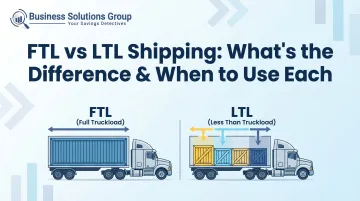
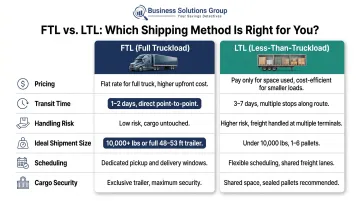
FTL vs. LTL: Quick Comparison
| Factor | FTL | LTL |
|---|---|---|
| Pricing | Flat or per-mile rate for entire trailer | Per-hundredweight, based on freight class + dimensions |
| Transit Time | Direct; 1–2 days regional | Multi-stop; 3–6 days depending on distance |
| Handling Risk | Loaded once, sealed until delivery | Handled 4+ times across terminals |
| Ideal Shipment Size | 10,000+ lbs or 6+ pallets | 150–10,000 lbs, up to 6 pallets |
| Scheduling | Fixed pickup/delivery appointments | Flexible windows, more accessorial options |
| Cargo Security | High—one carrier, one seal | Lower—multiple handoffs increase exposure |
What Is FTL Shipping?
FTL (Full Truckload) shipping means a shipper reserves the entire trailer—typically a 53-foot dry van—for their freight alone. The truck moves directly from origin to destination without intermediate stops, regardless of whether the load fills the trailer completely.
Pricing and Transit
FTL rates are quoted as either a flat fee or a per-mile rate. According to DAT's January 2026 rate release, the national average spot van rate hit $2.29/mile in December 2025, with contract rates averaging $2.46/mile. These rates are predictable compared to LTL's class-based structure, which makes FTL budgeting easier to forecast for high-volume lanes.
Transit is faster and more reliable. Regional FTL shipments typically deliver in 1–2 business days; the same lane via LTL adds 3–5 days due to terminal stops and consolidation.
Operational Advantages
- Single handling event: freight is loaded at origin and untouched until delivery
- Simplified paperwork: one bill of lading, one carrier, one tracking record to manage
- No freight class requirements: pricing isn't affected by density or stowability classifications
- Stronger chain-of-custody: critical for high-value or regulated goods
Partial Truckload (PTL): The Middle-Ground Option
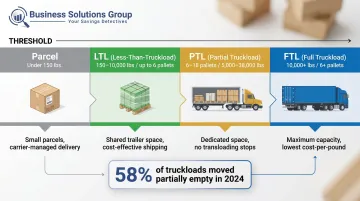
Partial Truckload (PTL) fills the gap for shipments of 6–18 pallets or roughly 5,000–38,000 lbs—too large for standard LTL, but not enough to justify a full trailer. PTL moves faster than LTL with fewer handling touchpoints and skips the terminal hub-and-spoke network entirely. For shippers in that mid-size range, running a PTL quote before defaulting to either standard mode often uncovers meaningful cost and time savings.
When FTL Makes Sense
With PTL as a fallback for mid-sized loads, here's when standard FTL is the right call:
- Shipment exceeds 10,000 lbs or 6+ pallets
- Delivery has a firm, non-negotiable deadline (retail replenishment, production line supply, product launches)
- Cargo is fragile, perishable, or high-value and cannot tolerate multiple handoffs
- You're shipping temperature-controlled goods requiring sealed, controlled environments
- Chain-of-custody documentation is required (consumer electronics, pharmaceuticals, automotive components)
What Is LTL Shipping?
LTL (Less-Than-Truckload) shipping consolidates freight from multiple shippers into one trailer. Each shipper pays only for the space their goods occupy. Per NMFTA guidelines, LTL covers shipments between 150 and 10,000 lbs that benefit from palletized transport.
How LTL Pricing Works
LTL rates are calculated per hundredweight (CWT) using the NMFC freight class system—18 classes ranging from Class 50 (dense, easy to handle, lowest rate) to Class 500 (light, bulky, highest rate). Four factors determine your freight class:
- Density (weight per cubic foot)
- Stowability (how well it fits with other freight)
- Handling (ease of loading/unloading)
- Liability (value, fragility, perishability)
The Accessorial Problem
Base LTL rates are rarely what you actually pay. According to RXO, accessorial charges can represent 10% to 40% of the total LTL invoice. Fuel surcharges alone frequently add 20–40% to base line-haul rates. Common fees that catch shippers off guard:
- Liftgate service (pickup or delivery without a dock)
- Residential delivery surcharges
- Inside delivery fees
- Reweigh/reclassification fees (when your declared class doesn't match carrier measurements)
- Detention charges
Miscategorized freight classes are one of the most consistent cost leaks in LTL shipping. Shippers often declare an incorrect class, then absorb reclassification fees at the terminal that could have been avoided with accurate upfront measurement.
These hidden costs add up fast, which is why understanding Volume LTL as an alternative pricing structure matters for mid-size loads.
Volume LTL: The Middle Option
For loads of 6+ pallets weighing 8,000–10,000 lbs, Volume LTL offers a different pricing structure based on linear feet of trailer space rather than strict freight class and CWT. Volume LTL rates can undercut standard LTL for these shipments, so request a separate quote before defaulting to FTL or standard LTL.
When LTL Makes Sense
LTL works best when:
- Shipment is under 10,000 lbs and 6 pallets or fewer
- Delivery window is flexible (3–6 business days acceptable)
- Goods are durable and can withstand multiple handling touchpoints
- You're an SMB or e-commerce brand restocking regional distribution centers periodically
- Cash flow favors paying only for space used rather than reserving full capacity
FTL vs. LTL: Which Option Is Right for Your Business?
There's no universal answer. The right mode for each shipment depends on four variables, evaluated in this order:
1. Shipment Size and Pallet Count
This is the primary trigger. Under 6 pallets or 10,000 lbs? Start with LTL quotes. Over that threshold? FTL or PTL is almost always more cost-effective. The Flock Freight 2025 Shipper Research Study found that 58% of truckloads moved partially empty in 2024, averaging only 37% utilization—largely because shippers default to FTL for mid-sized loads that would cost less via PTL or Volume LTL.
2. Delivery Urgency
If there's a firm delivery deadline, FTL is almost always the right call. LTL transit times are variable by design—multi-stop routes mean delays compound. For a retail floor set date or a production line feed, that unpredictability is unacceptable.
3. Cargo Sensitivity
Fragile, perishable, or high-value goods warrant FTL regardless of size. LTL freight passes through a minimum of four handling events: local pickup, origin terminal, destination terminal, and local delivery. Each touchpoint adds damage exposure. The LTL industry has improved significantly—the Synchro LTL Claims Index shows a 41% decline in claims ratios from 2020 to 2025—but FTL's sealed-trailer model still carries materially lower inherent risk.
4. True Cost Comparison
LTL is not always cheaper. Consider this scenario:
8-pallet shipment priced two ways:
- Standard LTL: Base rate + freight class surcharge + fuel surcharge (25% of base) + liftgate fee = total cost inflated 30–40% above the line-haul rate
- Partial Truckload: Flat market rate for 8 pallets, no accessorials, faster delivery
At this load size, PTL or a partial FTL booking often wins on total cost—not just per-pound rate. Business Solutions Group's freight spend analysis regularly reveals exactly these crossover points, where clients assume LTL is cheaper but the accessorial stack tells a different story.
Mixed-Mode Strategy
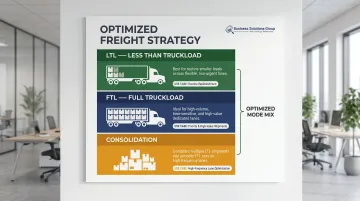
Once you've run the cost math, the pattern becomes clear: no single mode wins every lane. Most experienced shippers blend approaches based on load size, timing, and sensitivity:
- Use LTL for routine smaller loads on flexible lanes
- Use FTL for high-volume, time-sensitive, or high-value lanes
- Consolidate multiple LTL shipments into periodic FTL runs on high-frequency lanes to capture flat-rate economics
Sustaining those savings requires ongoing spend analysis, not a one-time review. Business Solutions Group's freight advisory service includes a no-cost benchmark analysis covering 6–12 months of shipment data. It compares your current carrier rates against market benchmarks across LTL, FTL, and PTL lanes. Clients typically see 20–25% reductions in freight spend once mode selection and rate structures are optimized.
Conclusion
FTL and LTL solve different problems. Neither is inherently better—the right answer is always determined by the specific combination of shipment size, timeline, cargo type, and actual landed cost (not just the base rate).
Businesses that match each shipment to the right mode—and periodically benchmark their carrier rates against the market—consistently reduce freight spend, improve delivery reliability, and protect product integrity.
That starts with knowing whether your current mode mix is working. Business Solutions Group offers a complimentary freight spend analysis that identifies where you may be overspending or using the wrong mode across your lanes—completed within 3–5 business days, with no commitment required.
Frequently Asked Questions
What is the difference between LTL and FTL?
FTL gives a shipper exclusive use of a full trailer for direct, point-to-point delivery—no intermediate stops, no shared space. LTL consolidates freight from multiple shippers into one trailer, with each shipper paying only for their portion of space but accepting more handling touchpoints and less predictable transit times.
What does FTL and LTL mean in trucking?
FTL stands for Full Truckload and LTL stands for Less-Than-Truckload. Both terms describe how much trailer space a shipper's freight occupies and how the carrier prices and routes that load—exclusively reserved versus shared across multiple customers.
What does LTL service mean?
LTL service is a freight shipping mode where a carrier combines smaller shipments from multiple customers into one trailer. Each business pays only for the space their goods occupy, making it cost-effective for shipments that don't fill a full trailer.
Which is cheaper, LTL or FTL?
LTL is typically cheaper for loads under 6 pallets or 10,000 lbs. For larger shipments, FTL's flat rate often becomes more cost-effective per pound—especially once accessorial fees and freight class surcharges are added to the LTL invoice.
At what weight is it cheaper to use LTL instead of parcel?
LTL generally becomes more cost-effective than parcel shipping at around 150 lbs. Parcel carriers are designed for shipments under 150 lbs, while LTL covers palletized freight from 150 lbs to 10,000 lbs—a range where parcel rates per pound become significantly less competitive.