Introduction
Telehealth has moved well past its pandemic-era origins. According to the AMA, 71.4% of physicians used telehealth weekly in 2024 — up from just 25.1% in 2018. Meanwhile, the global telehealth market reached $123.26 billion in 2024 and is projected to hit $455.27 billion by 2030.
That scale comes with a data problem. Virtual visits, remote patient monitoring (RPM) streams, asynchronous messaging logs, and wearable feeds produce more clinical and operational data than most organizations can effectively use. Collecting it isn't the challenge — acting on it is.
Healthcare analytics platforms exist to bridge that gap. This guide covers the five best options for telehealth in 2026 — what each does well, which features matter most, and how to match a platform to your organization's virtual care model.
Key Takeaways
- Healthcare analytics platforms built for telehealth unify virtual visit data, RPM feeds, EHR records, and patient engagement signals
- Top platforms for 2026: Innovaccer, Microsoft Azure Health Data Services, Health Catalyst, SAS Health Analytics, and Google Cloud Healthcare API
- Look for FHIR/HL7 interoperability, HIPAA/BAA compliance, real-time virtual care KPIs, and AI-driven risk stratification
- Unlike standard healthcare BI, telehealth platforms must handle asynchronous care data, wearable streams, and virtual-care-specific metrics
- The wrong platform creates fragmented data, compliance gaps, and missed early interventions for high-risk remote patients
Healthcare Analytics Platforms and the Telehealth Opportunity
Healthcare analytics platforms built for telehealth go well beyond EHR reporting. In a virtual care context, they unify data from multiple sources into dashboards and predictive models that clinical and operational teams can act on:
- Virtual visit records and encounter summaries
- Remote patient monitoring (RPM) device feeds
- Asynchronous communication logs
- Population health signals and risk stratification data
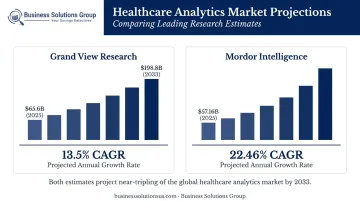
The market supporting this infrastructure is substantial. Grand View Research estimates the global healthcare analytics market at $65.6 billion in 2025, projected to reach $198.8 billion by 2033 at a 13.5% CAGR. Mordor Intelligence puts the 2025 figure at $57.16 billion with a faster 22.46% CAGR — the two sources diverge on pace, but even the conservative estimate points to a market nearly tripling in size by 2033.
Virtual care is no longer a supplement to in-person delivery. The AHA describes telehealth as "now a routine way" for patients to access care and providers to access specialist consults. That shift changes the evaluation criteria. General BI capability matters less than how deeply a platform integrates with virtual care workflows — and whether it can surface actionable insights from the fragmented data telehealth generates. The platforms below are ranked with that standard in mind.
Best Healthcare Analytics Platforms for Telehealth in 2026
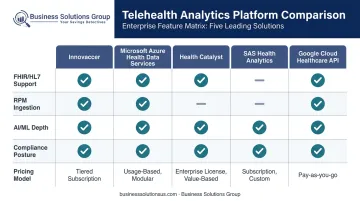
These platforms were evaluated on telehealth integration capability, HIPAA compliance posture, AI/ML depth, FHIR/HL7 interoperability, KLAS or Gartner recognition, and documented adoption in virtual care settings.
Innovaccer
Innovaccer's Data Activation Platform (DAP) is designed to unify clinical, claims, and patient engagement data into a single patient 360 view. Its FHIR-enabled virtual care positioning makes it particularly relevant for telehealth workflows, where disconnected visit platforms and care management tools routinely delay risk identification.
The platform's strength for telehealth lies in its ability to ingest disparate sources — including telehealth visit records — and apply predictive risk scoring and automated care gap identification across remote patient populations. Innovaccer earned a 2025 Best in KLAS award in the CRM category with a score of 94.5, reflecting strong client adoption in health system environments.
| Category | Detail |
|---|---|
| Key Features | Data Activation Platform, AI-driven population health, care management workflows, FHIR-enabled telehealth data ingestion, care gap identification |
| Compliance Posture | HITRUST CSF certified, SOC 2 Type II, HIPAA-aligned — verify current status |
| Pricing | Enterprise/custom pricing — contact vendor directly |
Microsoft Azure Health Data Services
Azure Health Data Services is a cloud-native platform built for healthcare organizations already operating within Microsoft infrastructure. It supports FHIR R4, DICOM, and MedTech service standards — all directly relevant to telehealth and RPM data exchange.
Its MedTech service ingests device data, transforms it into FHIR Observations, and persists it in the FHIR service. This pipeline removes the need for custom ETL work in RPM-heavy telehealth programs. The platform connects health data to Azure's broader analytics and ML workloads, supporting predictive modeling on remote patient monitoring streams without requiring a separate data pipeline.
| Category | Detail |
|---|---|
| Key Features | FHIR R4 and DICOM support, MedTech service for RPM/wearable ingestion, Azure analytics and ML integration, NLP for clinical notes |
| Compliance Posture | HIPAA-eligible services with BAA support — verify in-scope services |
| Pricing | Usage-based/pay-as-you-go — verify current rates via Azure pricing calculator |
Health Catalyst
Health Catalyst specializes in outcomes improvement analytics for large health systems. Its Late-Binding™ Data Warehouse architecture supports complex telehealth data integration projects where multiple EHR environments, care settings, and operational data sources need to be reconciled.
The platform's ML-driven analytics layer integrates telehealth visit data alongside clinical and operational data to surface outcomes trends, support care gap management, and reduce readmissions. Health Catalyst's bundled professional services model sets it apart: organizations get implementation expertise alongside the platform, not just a license to figure it out themselves.
| Category | Detail |
|---|---|
| Key Features | Late-Binding™ Data Warehouse, ML-driven outcomes analytics, EHR integration, telehealth workflow analytics, care management modules |
| Compliance Posture | HIPAA-aligned, SOC 2 Type II, HITRUST CSF — verify current status |
| Pricing | Enterprise licensing plus professional services — contact vendor for current model |
SAS Health Analytics
SAS Health is built on the SAS Viya platform, combining data management, governed AI, and specialized health analytics for payers, providers, and life sciences organizations. SAS brings decades of statistical modeling depth to a field where explainability and bias monitoring are required for regulatory review and clinical accountability.
For telehealth, SAS Viya supports predictive modeling on remote patient data, population segmentation by risk tier, and care quality visualization across hybrid delivery models. Its AI governance tools — fairness testing, bias detection, and model lifecycle management via SAS Model Manager — address the compliance requirements that most telehealth programs face as they scale.
| Category | Detail |
|---|---|
| Key Features | SAS Viya platform, predictive modeling and patient segmentation, population health risk scoring, explainable AI and bias monitoring, data visualization |
| Compliance Posture | HIPAA listed in compliance frameworks, SAS Information Governance for data asset management — verify current certifications |
| Pricing | Flexible licensing with on-premise and cloud-based options — verify current tiers with vendor |
Google Cloud Healthcare API
Google Cloud Healthcare API provides healthcare organizations with structured and unstructured data access using FHIR R4, HL7v2, and DICOM standards, combined with Google's AI and ML ecosystem at scale.
Its FHIR-native data layer enables real-time exchange between telehealth apps and analytics pipelines, while batch export to BigQuery opens large-scale analysis of virtual visit logs and patient-reported outcomes. Google Cloud positions Vertex AI as the enterprise layer for custom predictive models on RPM and telehealth data — an option that scales from digital health startups to full enterprise deployments without platform changes.
| Category | Detail |
|---|---|
| Key Features | FHIR R4/HL7v2/DICOM API layer, BigQuery FHIR export for large-scale analytics, Vertex AI integration for ML modeling, AutoML capabilities |
| Compliance Posture | Cloud Healthcare API is a covered service under the Google Cloud HIPAA BAA — verify current coverage |
| Pricing | Pay-as-you-go — verify current rates on Google Cloud pricing page |
Key Features to Look for in a Telehealth Analytics Platform
Choosing the right telehealth analytics platform comes down to a specific set of capabilities — most general-purpose BI tools weren't built for clinical data environments. Here's what to evaluate.
HIPAA and HITECH Compliance for Telehealth-Sourced PHI
Telehealth creates a distinct compliance surface. Video visit recordings, asynchronous messaging logs, and RPM data streams each carry PHI — and each requires BAA coverage, end-to-end encryption, and audit trails. Per HHS guidance, all telehealth services provided by covered entities must comply with HIPAA Rules. Verify that the platform's BAA explicitly covers every telehealth data stream your organization generates.
FHIR and HL7 Interoperability
Without native FHIR R4 or HL7 v2 support, telehealth data becomes siloed from the broader clinical record. Platforms offering pre-built connectors for video platforms, wearables, and patient portals cut integration time and reduce custom development costs. HL7 v2 remains the most widely used health information exchange standard in the U.S. — legacy ADT and order feeds still power many telehealth operations.
Real-Time Virtual Care Analytics
Telehealth requires a different KPI layer than traditional clinical reporting. Key metrics include:
- Virtual visit completion rates
- No-show rates by care setting and modality
- Average time to care for virtual vs. in-person encounters
- Patient-reported experience scores for telehealth visits
- Remote engagement scores across asynchronous channels
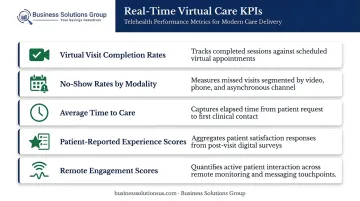
These need to surface in configurable, real-time dashboards — not quarterly reports.
Predictive Analytics for Remote Patient Populations
Peer-reviewed evidence from PMC found remote health monitoring reduced hospital readmissions with an RR of 0.67 and ED visits with an RR of 0.56. The clinical value of telehealth analytics depends on identifying high-risk patients before they escalate, not reacting after escalation has already occurred. Platforms should apply AI-driven risk stratification on RPM data streams in near real-time.
Scalability for Hybrid and Multi-Channel Care
As care moves between in-person, telehealth, and asynchronous channels, the platform must maintain a unified patient record across all touchpoints. Assess whether it handles multi-site or multi-state deployments without performance degradation. It should also scale with patient volume growth without requiring architectural rework.
How We Chose the Best Healthcare Analytics Platforms
Evaluation Framework
Each platform was assessed across five criteria:
- Telehealth integration depth — ability to ingest virtual visit records, RPM feeds, and asynchronous care data
- HIPAA compliance posture — BAA support, encryption standards, audit trail capability
- AI/ML analytical capability — depth of predictive modeling and risk stratification features
- FHIR/HL7 interoperability — standards support for clinical data exchange
- Industry recognition — KLAS Research rankings or Gartner market presence in healthcare analytics or population health categories
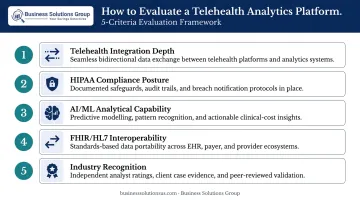
Across all five criteria, the most common pitfall is selecting a general-purpose BI tool without verifying its readiness for telehealth-specific data workflows — particularly RPM ingestion and asynchronous care log handling.
Business and Operational Factors
Platform selection should connect directly to measurable outcomes. Key considerations beyond feature lists:
- Total cost of ownership — implementation, training, and ongoing licensing costs can dwarf the base platform fee
- Vendor support quality — particularly for high-volume telehealth data integrations
- ROI evidence — look for documented improvements in care gap closure rates, reduced no-show rates, or better chronic disease management for remote populations
Organizations evaluating platform costs can also benefit from third-party spend advisory support. Business Solutions Group provides vendor contract benchmarking and technology spend analysis — services that help organizations assess total cost of ownership for cloud platforms and SaaS licensing before committing.
Conclusion
The right healthcare analytics platform for telehealth isn't determined by market position alone. It needs to match your organization's virtual care model, data infrastructure maturity, compliance requirements, and the specific outcomes you're trying to drive for remote patients.
Use the key features framework and evaluation criteria in this guide to build a shortlist. Then prioritize live demos and pilot programs to validate fit, especially for RPM data ingestion and FHIR interoperability, where paper claims and live performance often diverge.
Organizations finalizing platform contracts should also scrutinize vendor pricing structures, SaaS licensing terms, and total cost of ownership before committing. Business Solutions Group specializes in vendor contract benchmarking and spend optimization advisory, helping businesses identify cost reduction opportunities across technology and service agreements. Connect with Business Solutions Group to request a no-cost advisory assessment.
Frequently Asked Questions
What are the best healthcare data analytics platforms for telehealth integration?
The strongest options for 2026 are Innovaccer, Microsoft Azure Health Data Services, Health Catalyst, SAS Health Analytics, and Google Cloud Healthcare API. The best fit depends on your telehealth model, existing EHR environment, and compliance requirements — there's no single answer across all organizations.
How is telehealth currently integrated in healthcare?
Telehealth integrates with clinical infrastructure through FHIR/HL7-compliant data exchange standards that connect virtual visit platforms, RPM devices, and patient portals to EHR systems and analytics layers. It now functions as a routine care delivery channel across both primary and specialty care — embedded in standard workflows rather than bolted on.
What features should a healthcare analytics platform have for telehealth?
Key features to prioritize:
- HIPAA compliance with explicit BAA coverage for telehealth-sourced PHI
- Native FHIR interoperability for seamless data exchange
- Real-time virtual care KPI dashboards
- RPM device data ingestion
- AI-driven risk stratification for remote patient populations
How do healthcare analytics platforms support remote patient monitoring?
These platforms ingest continuous biometric data from RPM devices — glucose monitors, blood pressure cuffs, wearables — apply predictive models to flag deteriorating trends, and surface actionable alerts to care teams before adverse events occur.
Are healthcare analytics platforms for telehealth HIPAA compliant?
Leading platforms offer HIPAA-eligible infrastructure and Business Associate Agreements, but organizations must verify that all telehealth data streams — including video visit logs and asynchronous messaging — fall within the covered scope of the BAA, not just core EHR data.
What is the difference between a general healthcare analytics platform and a telehealth-specific one?
General platforms focus on EHR and claims data. Telehealth-optimized platforms also ingest virtual visit data, RPM device streams, and asynchronous care logs. They surface KPIs specific to virtual care delivery — visit completion rates, remote engagement scores, and telehealth-attributed care gap closure.